Story · Changelog · No 05

The short version, in eight cards

parallaxlens.com/s/2026-06-04-ai-coding-token-bill
Parallax · Story 1 / 8
Parallax medallion, tech desk
Changelog · No 05

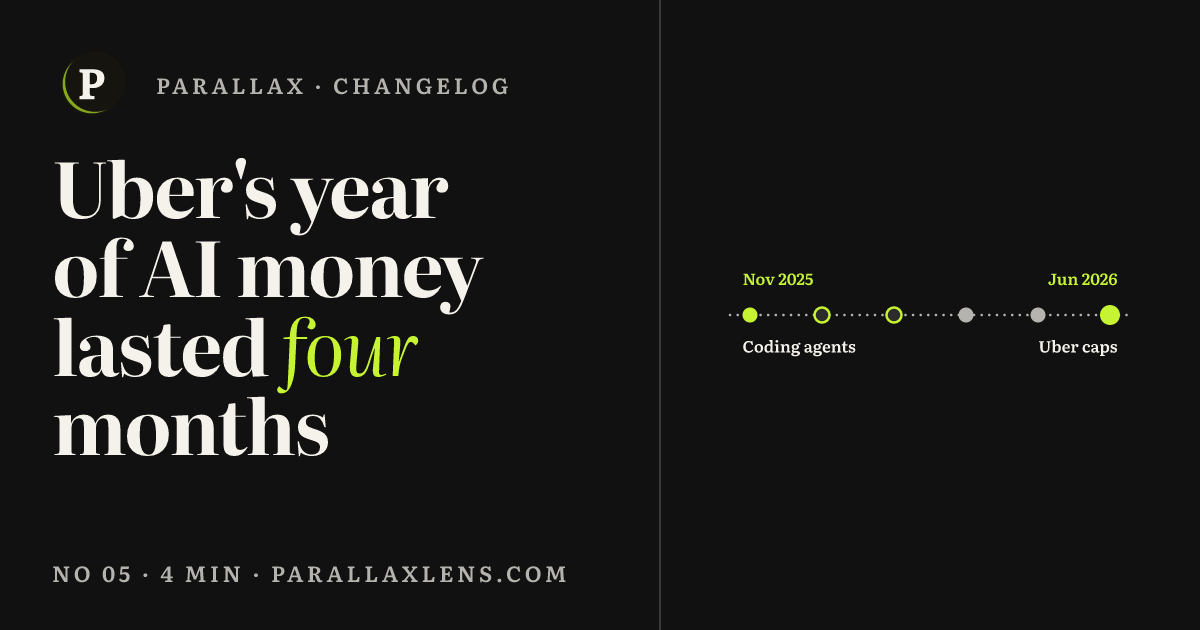
Uber's year of AI money lasted four months

You keep hearing AI is getting cheaper. Uber burned its whole 2026 AI budget in four months, and capped every engineer.

4 Jun 2026 · 4 min read · 7 sources
Swipe up Swipe
Changelog · No 05 2 / 8
THE ARITHMETIC

Cheaper tokens, bigger bills

What most people think

AI gets cheaper every year, so a company's AI bill in 2026 should be smaller than its bill in 2025.

What the data shows

4months

Cheaper tokens, bigger bills

Source · Bloomberg (Natalie Lung) via Simon Willison's Weblog · 3 June 2026

Changelog · No 05 3 / 8
TOKENS PER TASK

One job, over a million tokens

1,363,250 GPT-5 Codex task (measured)
10K 100K 1M 1 1.25 1.5 1.75 2 0 500K 1M 1 1.25 1.5 1.75 2 one chat reply* GPT-5 Codex task (measured) one chat reply*GPT-5 Codex task (measured) one chat reply*GPT-5 Codex task (measured) task autonomy → tokens consumed (one task) (log) tokens consumed (one task) The only measured point here.One task, 1.36 million tokens. The only measured point here.One task, 1.36 million tokens.
10K 100K 1M 1 1.25 1.5 1.75 2 0 500K 1M 1 1.25 1.5 1.75 2 one chat reply* GPT-5 Codex task (measured) one chat reply*GPT-5 Codex task (measured) one chat reply*GPT-5 Codex task (measured) task autonomy → tokens consumed (one task) (log) tokens consumed (one task) The only measuredpoint here. Onetask, 1.36 million tokens. The only measuredpoint here. Onetask, 1.36 million tokens.

Log y-axis · equal steps are equal multiples.

So how many of those pieces does one job use? A chat reply is a few thousand of them. One measured coding job used over a million.

Source · Simon Willison's Weblog, llm-pricing. Lower point illustrative, not measured · 4 June 2026

Changelog · No 05 4 / 8
INSIDE ONE TASK

Most of it was re-reading

tokens · one task
1,176,320 cached tokens

So the loop re-sends everything it already has, on every step. Here is one real coding task, split three ways. Cached means the pieces the agent had already sent once.

Source · Simon Willison's Weblog, llm-pricing · 4 June 2026

Changelog · No 05 5 / 8
HOW IT HAPPENED

Billing changed, prices rose, budget gone

2025
Coding agents start mostly working.
2026
OpenAI starts billing Codex by the token.
Anthropic starts billing the seat by usage.
New frontier model, twice the price.
Uber's 2026 AI budget is exhausted.
Uber caps engineers at $1,500 per tool.

Almost all of that task was context the agent re-sent. Now watch what the billing did next. Frontier means the newest and most capable model on sale.

Source · Simon Willison's Weblog · 19 May to 3 June 2026

Changelog · No 05 6 / 8
THE CAP

One engineer, one tool, one month

Per engineer, per tool

$1,500/month

A median Uber US engineer's total pay is around $330,000 (about ₹3.1 crore), an outside estimate, not a company figure.

  • About ₹1.4 lakh a month, for one person and one tool.

  • A year of that cap, on two tools, is roughly $36,000. Assuming an engineer uses two tools.

So the cap arrived on 2 June, one limit for each engineer on each tool. It covers only the tools that write and run code on their own.

Source · Bloomberg (Natalie Lung) via Simon Willison's Weblog. Levels.fyi for the pay estimate. Converted at about ₹95 to the dollar, September 2026 · 3 June 2026

Changelog · No 05 7 / 8
THE BILL ELSEWHERE

Where else the money moved

Tokens one heavy user burned in 30 days
$2,180
Newest top model's price against the last one
2×
Cost rise with the price per piece unchanged
~1.4×
Of a median engineer's estimated total pay
~11 %

So one engineer with two tools can spend $36,000 a year. Here are four more readings, taken off other meters.

Source · Simon Willison's Weblog. Levels.fyi for the pay estimate · 20 April to 3 June 2026
Changelog · No 05 8 / 8
The whole issue

That's the short version.

9 sections
7 sources, linked
4 minutes
Still in the issue
  • Three words
  • Changed
  • Actually moved
Read the whole issue
Share