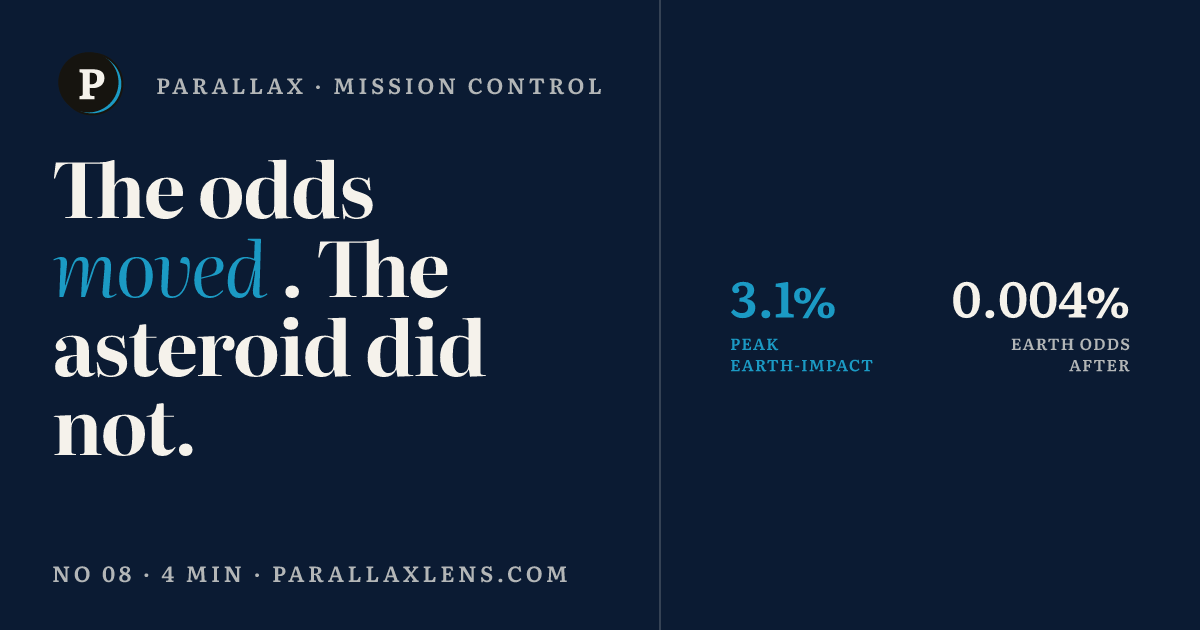
The short version, in six cards
An asteroid's chance of hitting Earth once read 1 in 32. Six days later, 1 in 25,000. The rock you were watching never moved.
4 Jun 2026 · 4 min read · 8 sourcesWhat most people think
The odds kept getting revised down, so the whole thing must have been an overreaction that scientists quietly walked back.
What the data shows
3.1% → 0.004%in six days
Same rock, same orbit, the whole time. In February 2025 the odds of it hitting Earth read about 1 in 32. Six days later, 1 in 25,000. Nothing moved out there.
Source · NASA Planetary Defense blog
Spotted in December 2024. Peak Earth odds in February 2025. Ruled out six days later, and then the risk shifts to the Moon and climbs through 2025. Cleared on 5 March 2026.
Source · NASA Planetary Defense and Webb blogs, with ESA
Six figures from the whole episode. 1%, about 1 in 32. 3%. Size 53 to 67 metres. Miss distance more than 20,000 km. Only the size belongs to the rock. Same asteroid, same orbit, the whole time.
Source · NASA Planetary Defense blogs and 2024 YR4 Facts, with ESA Planetary Defence
This update reflects improved precision in our understanding of where the asteroid is expected to be in 2032 rather than a shift in its orbital path.
The agency that published every one of those numbers explained the last update in one sentence. The change reflected improved precision about where the asteroid would be in 2032, rather than a shift in its orbital path.
Source · NASA Planetary Defense blog · 5 March 2026